MCP · Claude · BigQuery · Data quality
Insights in under a minute. But not by magic.
How MCP is changing the speed of business decisions and why data quality is still the foundation.
How long does it take your organization to answer a business question about years of historical data with millions of records?
Are your decisions moving faster than your competition, or are you still waiting on a report that takes two days to arrive?
By the time that report lands in your inbox, the window to act may already be closed.
To demonstrate the real power of MCP, we built a case from scratch. We took one of the most well-known public datasets in the world, fourteen years of Stack Overflow questions, the platform where millions of developers go when they are stuck. Twenty-three million records spanning from 2008 to 2022.
We built a data architecture on top of it, connected it to Claude through MCP, and asked business questions in plain English.
Every answer came back in under sixty seconds. With charts. With trends. With executive analysis grounded in real data.
The moment that changes everything
Imagine asking a question about your business data out loud, in plain English, the way you would ask a colleague, and getting a full analysis with charts, trends, and executive insights in under sixty seconds. No SQL. No waiting for a report. No ticket to the BI team.
That is what we recorded this week, live, on top of fourteen years of Stack Overflow data. Twenty-three million records. Three data layers. One question. Fifty+ seconds.
The technology that made it possible is called MCP.
What is MCP and why does it matter
MCP stands for Model Context Protocol. In plain terms, it is the bridge that allows AI models like Claude to talk directly to your data sources, databases, data warehouses, APIs, in real time.
Before MCP, AI tools worked with whatever text you pasted into a chat window. The intelligence was there, but the data was not. You had to copy, export, clean, and manually provide context every single time.
MCP changes that fundamentally. Claude now connects directly to your BigQuery tables, your Snowflake warehouse, your databases. It reads the schema, understands the structure, writes the query, executes it, and interprets the results, all in a single conversation.
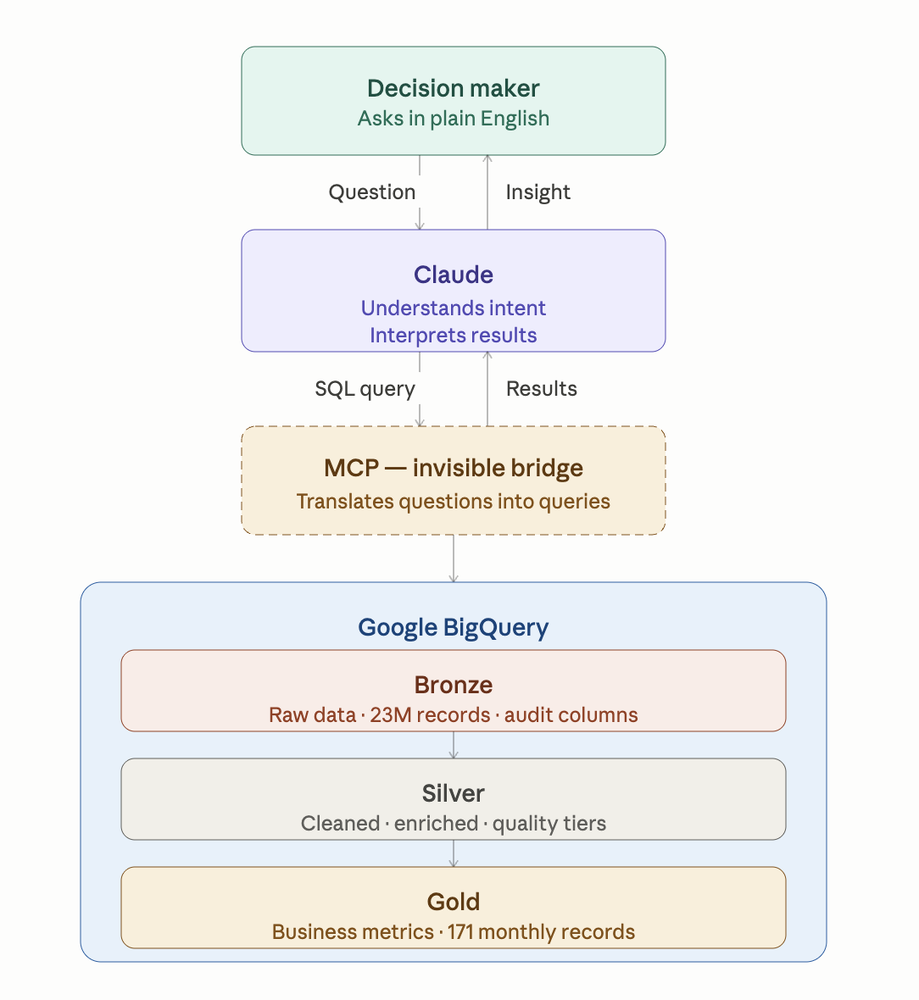
The result is what we saw this week. A business question asked in plain English. An answer grounded in real data, with charts and insights, in under a minute.
For decision makers, this is not a technical upgrade. It is a speed upgrade. The gap between a question and an answer, which used to take hours or days depending on your data team's availability, compresses to seconds.
The catch, and this is important
Here is what nobody tells you in the AI hype cycle: the speed is real, but it is not free. It did not come from Claude being magical. It came from the data being ready.
Before we ran a single AI query, we spent time building what is called a Medallion architecture, three layers of data, each one more refined than the last.
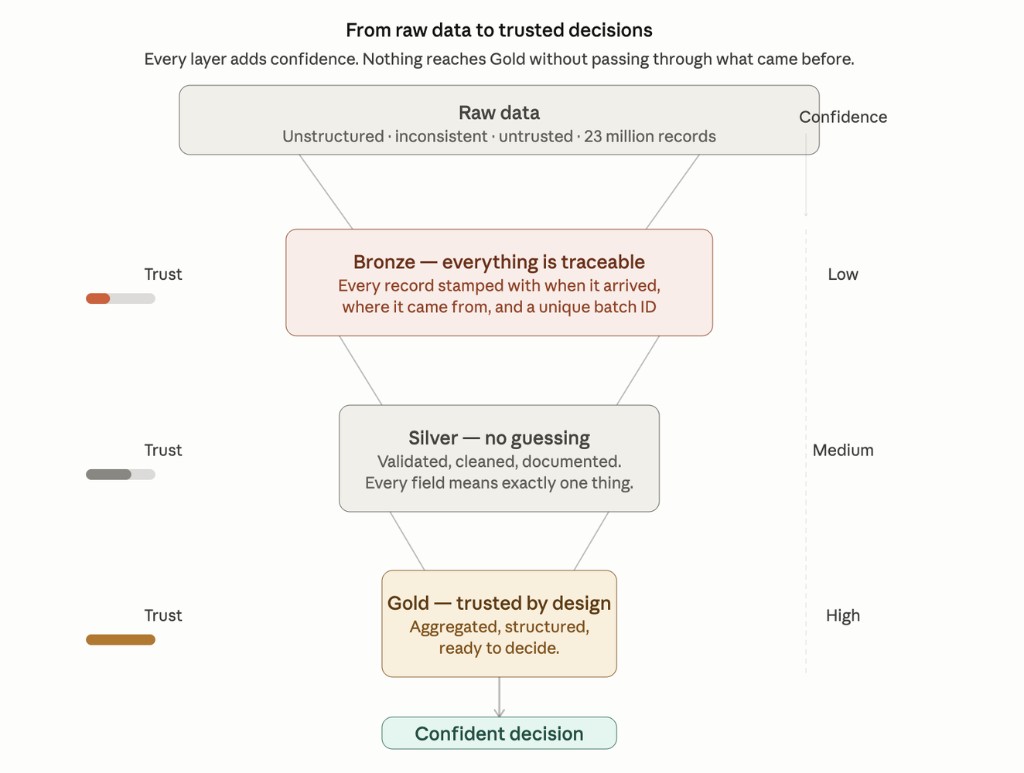
Bronze is the raw layer
Every record from the source, loaded exactly as it arrived, with audit columns that tell you when it came in, where it came from, and a unique identifier for each load batch. Nothing is transformed. Everything is traceable.
Silver is the clean layer
Here the data gets normalized, enriched, and validated. Dates become consistent. Tags that were stored as pipe-separated strings become proper arrays. Each question gets classified into a quality tier. Invalid records get flagged, not deleted. This is where the trust is built.
Gold is the business layer
Silver gets aggregated into metrics that answer actual business questions, monthly activity, answer rates, engagement trends, quality distributions. Twenty-three million rows become one hundred and seventy-one clean monthly records, each one ready to be queried, charted, or analyzed.
When Claude connected to our BigQuery tables and someone asked "if Stack Overflow were a company, what would this data tell us about its business health", Claude did not guess. It queried the Gold layer, read structured, validated, documented data, and produced a coherent executive analysis.
That is not magic. That is architecture.
What data quality actually means for AI
There is a phrase in data engineering that predates AI by decades: garbage in, garbage out. It has never been more relevant than it is today.
When an executive asks Claude a question and the underlying data has duplicates, inconsistent date formats, undocumented fields, and no quality classification, Claude will still produce an answer. It will sound confident. It may even look professional. But it will be wrong in ways that are hard to detect.
The Medallion architecture exists precisely to prevent that. It is a contract between the data team and the business that says: by the time data reaches the Gold layer, it has been validated, documented, and structured for the questions you are going to ask.
The speed of the AI insight is the reward for the discipline of the data work that came before it.
What this means for your organization
The most expensive resource in any data driven organization is not storage. It is not compute. It is the time between a question and a trusted answer.
Right now, in most companies, that gap looks like this. An executive has a question. It goes to the data team. The data team queues it behind three other requests. A report gets built and sent back two days later. By then the decision has already been made on intuition rather than evidence.
MCP connected to a well structured data architecture collapses that gap. The executive asks the question directly. The answer comes back in under a minute. The decision gets made with data, not instinct.
This is not about replacing data teams. It is about removing the bottleneck between their work and the people who need to use it. The data team builds and maintains the architecture. The business consumes it at the speed of thought.
The organizations that invest in data quality today are not just preparing for better dashboards. They are preparing for a world where every decision maker has a data analyst available to them at any moment, for any question, at no marginal cost per query.
We asked Claude questions about fourteen years of Stack Overflow data. We got charts, trends, business analysis, and executive recommendations, all in under a minute per question, all grounded in twenty-three million real records.
The AI was fast. But the data made it trustworthy.
If your organization is thinking about AI for decision making, the first question is not which model to use. The first question is whether your data is ready to be asked.
At Simov Labs we help companies build the data foundation that makes AI powered decisions possible. Not the hype. The architecture.
Tags: #MCP #BigQuery #DataEngineering #AIDecisionMaking #MedallionArchitecture #ModernDataStack #BusinessIntelligence #DataStrategy #Claude #GenerativeAI