Late Arriving Dimensions: How to Handle Delayed Dimension Data in a Data Warehouse
Preventing orphaned records and maintaining data accuracy.
Introduction
In a Data Warehouse, dimensions provide the necessary context to analyze transactional data. However, when dimension data arrives late, it can cause referential integrity issues, orphaned records in fact tables, and inconsistent reports.
This phenomenon, known as Late Arriving Dimensions, affects data quality and decision-making in an organization. How can we ensure that dimensions remain consistent and accurate even when information arrives late?
In this article we explore: what Late Arriving Dimensions are and why they occur; how they affect a Data Warehouse and BI reports; strategies to mitigate their impact; and best practices in dimension modeling for delayed data.
1. What Are Late Arriving Dimensions?
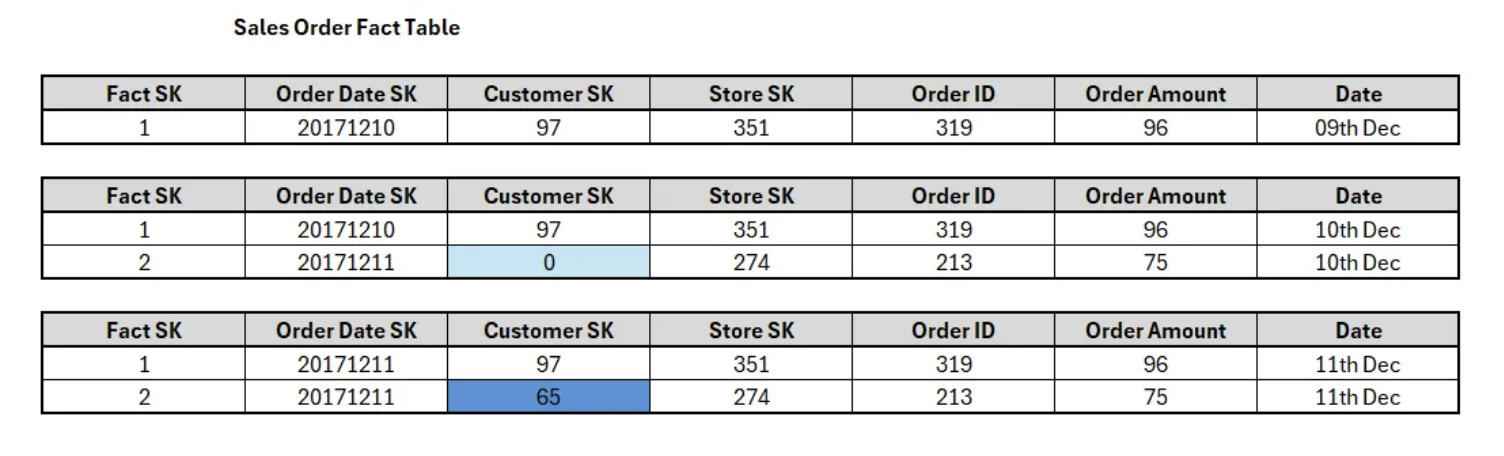
Late Arriving Dimensions occur when dimension records arrive after their related facts have already been recorded. This creates integrity issues in reports and inconsistencies in data relationships.
Example
- A customer makes a purchase on March 1st, but their CRM record is not entered until March 5th.
- The fact table stores the sale, but it does not find a reference in the Customer dimension.
- In sales reports, the customer appears as unknown or with a null ID.
These delays can happen due to manual processes, dependencies on external systems, synchronization failures, or ETL loading errors.
2. Impact on a Data Warehouse
When dimensions arrive late, they can cause multiple issues in data quality and report accuracy:
- Referential integrity errors: If a fact is stored with a dimension key that does not yet exist, the system may reject the insertion or mark the relationship as invalid.
- Orphaned records in the fact table: Events may be linked to null or incorrect dimension values.
- Reports with incomplete or incorrect data: A dashboard may show sales from unknown customers, leading to confusion in the analysis.
- Difficulty in retroactively correcting data: If a dimension arrives late and facts have already been processed, a strategy is needed to update the data correctly.
3. Strategies to Handle Late Arriving Dimensions
There are different approaches to mitigate the impact of Late Arriving Dimensions, ensuring that the Data Warehouse can handle these cases without losing integrity or accuracy.
3.1 Using Temporary Keys in Dimensions
- A temporary record in the dimension can be used with a placeholder key (e.g. ID = -1 or 0 for "Unknown Customer").
- When the actual data arrives, it updates the temporary key with the correct one.
- Benefit: The fact table can store the event without integrity errors, avoiding orphaned records.
3.2 Implementing Slowly Changing Dimensions (SCDs)
Depending on business requirements, dimensions can be managed with:
- SCD Type 1 (Overwrite): When late data arrives, it updates the dimension without preserving history. Ideal when only the latest state matters.
- SCD Type 2 (History with Dates): A new record is created with an accurate effective date to track historical changes.
- SCD Type 3 (Previous/Current Column): Stores both the previous and new value in separate columns. Useful when changes need to be compared.
Example (SCD Type 2): If a customer upgrades from Bronze to Silver on March 10th, but the update is received on March 15th, a new record is inserted with Effective Start Date = March 10th. This ensures that historical reports reflect the correct category.
3.3 Using Effective Dates in Dimensions
- Define Effective Start Date and Effective End Date in dimensions, not only the load date.
- The goal is to track when the data should have been available, not just when it was loaded.
- Example: A new product was sold on February 2nd, but its entry in the Product dimension was delayed until February 10th. The dimension record is added with Effective Start Date = February 2nd.
- Benefit: Allows correcting facts retroactively without affecting data consistency.
3.4 Retracting and Reprocessing Facts
Another approach is to reprocess affected facts once the dimension data becomes available:
- Mark pending facts when they do not have a valid dimension key.
- Run an update process once the dimension data arrives.
- Reprocess facts to assign the correct dimension keys.
Benefit: Ensures all reports reflect complete and correct data, and prevents inconsistencies in trend analysis and historical metrics.
Conclusion
Late Arriving Dimensions are a common challenge in Data Warehousing and Business Intelligence, but with the right strategies, their impact can be mitigated.
Key recommendations
- Use temporary keys (e.g. -1) to prevent referential integrity failures.
- Implement Slowly Changing Dimensions to maintain historical changes in data.
- Use Effective Start Date and Effective End Date to retroactively correct data.
- Design update processes that reprocess facts when dimensions arrive late.
If your company faces issues with late-arriving dimension data and inconsistent reports, we can help you design effective strategies to optimize your Data Warehouse. Contact us at team@simov.io.